
Glossy new skateboarding magazines seem to recurr like a case of athelete’s foot with every boom and bust cycle in skateboarding. A partial list of contenders includes Skateboarder, Poweredge, BIg Brother, Skateboarder (again and again) Homeboy, Slap, etc… Except for in the case of a complete vacum, most magazines don’t start during the downturns. One exception has been Concrete Wave Magazine. The magazine’s editorial stance is unlike any other. Is it a nostalgia collection for Barneys or a safe haven from yet another handrail and shoe advertisement magazine? Whatever your opinion, Concrete Wave has a steadily growing reading base of all ages. Aside from publishing and editing Concrete Wave magazine, he is also the author of Concrete Wave – the book, Skate Legends. What follows is an interview conducted via email, with editor Michael Brooke, who was too busy collecting photographs and words for his upcoming Buyer’s Guide to send us any decent pictures of himself and his operations!
– kilwag 2-22-05
Kilwag: Let’s get some of the basics out of the way. When and where you born, how long have you been skating, and how did you pick it up?
Born in Leeds, England in 64. I moved to Canada in 72. I lived in buffalo NY for a year (father took a sabbatical) and now reside in Toronto.
I saw my first skateboarder in the UK of all places…in 74! In Brighton. Then, in June of 75 the neighborhood kid had one…I tried it and have been hooked ever since.
How many skateboards do you own?
25+
How many do you actually ride?
Pretty well all of them….even my off road one.
Favorite all time setup?
That’s easy…Fibreflex, Bennetts and Road Rider 4’s – Damn I LOVED that board!
Favorite skate spot?
Vanderhoof is a nice park in Toronto – it’s a bit of a drive, but it’s mighty fun.
Favorite skater?
Mullen
How did Concrete Wave, the book, come into fruition? How well did it sell?
I was working at Xerox Corp trying to sell immense photocopiers/printers (called Docutechs) to book publishers. I wasn’t really getting anywhere – it’s freakin’ hard to sell copiers to publishers…it’s actually very hard to sell anything to a publisher! Anyway, at the time, I was also puttering around with this website my brother built for me. It was called The Skategeezer Homepage. This was started 1995. In 1997 I happened to contact a publisher by the name of Nick Pitt at Warwick Publishing. My sales skills must have worn him down and he agreed to meet me to learn about Xerox technology (oh boy!).
The meeting was going pretty straightforward (ie: he had no interest in copiers!) but when I started talking about the internet he perked up a little. I mentioned that I had my own website based on the history of skateboarding. He then said “that’s interesting – we’re looking at doing a book on skateboarding. Can you put together an outline?” Within two weeks I had an outline and within a few months, an advance. I then had to go out and do the research. Suffice to say, Xerox took a back seat! The book was a total fluke. No US publisher would touch it. The entire book was handled by Warwick. They have done pretty damn well with it…30,000 copies sold. A best seller is 10,000. So, I feel very proud to have done it…and it launched a brand new career for me.
What was your biggest initial obstacle to getting the magazine started? How hard was it to get into publishing in general?
After the book was completed, I had a lot of time on my hands. I made a decision to launch a magazine…hey..why not! So, I started to work on International Longboarder with a magazine designer called Tom Browne. I had met Tom back in 1976 in London Ontario. He was an avid skater and I turned him onto longboarding in 1997. So in January 1999, we got things rolling. Our first issue was launched on $50 worth of phone calls. Seriously. It was just insane. But we did it. Brad Strandlund helped out immensely trying to convince folks that we were legit.
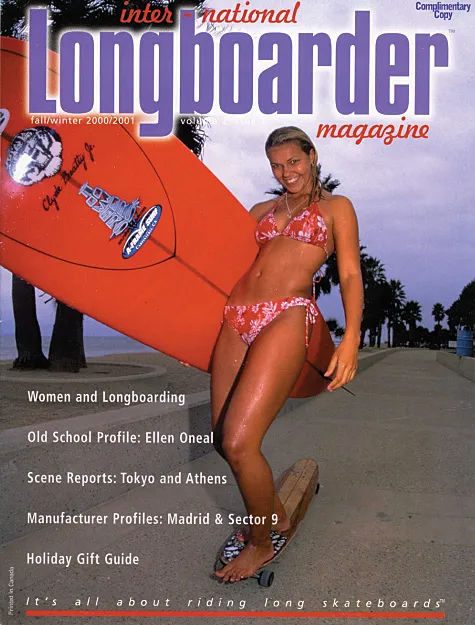
Slowly things built up…but the mag was too focused on one aspect of skateboarding and the market wasn’t (and to my mind still isn’t) ready for a longboard only mag. I learned a hell of a lot and got frustrated a lot.
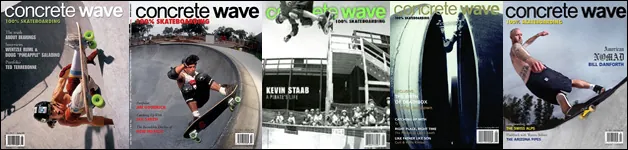
In the end, we packed it in after 3 years…Not bad really. But the truth is that I couldn’t do a full time job and run two magazines. I was going mental. Concrete Wave was started in the spring of 2002 (with $2500 – due to glossy stock!) as a reaction to what I saw was missing in the skate world and in International Longboarder.
How big is your operation and what is your current circulation?
Well we have our 20,000 foot office space in downtown Toronto and corporate jet…Just kidding. It’s me, Buddy Carr, Mike Moore, Blair Watson (my editors and confidants) and hundreds of contributors who do everything from submit articles to promote the mag at their local skate shop. It is the culmination of hundreds of people’s efforts that have made CW grow. We have a long way to go, but I am pleased with the pace and of course, incredibly humbled by so many people contributing to the cause.
Concrete Wave has a worldwide circulation of 20,000 copies. That’s about all we’ll be for some time. It’s manageable for the advertisers. If we need to grow, we will, but there is no rush.
Why start up another skateboard magazine, especially during a low point for the industry? What is the goal of the magazine?
It’s perfect timing as far as I’m concerned. For the last 15 years, all the other big skate mags refused to cover anything but street and the occasional vert shot. Sure, they USED to cover more stuff, but they took an executive decision not to. We intend to be proactive – not reactive….I am not concerned with who this upsets or what the “demographics” point to or what the hell the kids want. Young skate kids are BLANK SLATES….and right now, their diet of skate media is almost 100% street. It’s a continuous circle and I am happy to throw a wrench into the mix. If I can show the next generation that there is so much more than street, I will have accomplished a key goal.
I work with over 150 companies who, for whatever reason, can’t seem to get much attention from most of the other mags. CW aims to correct this. I’ll admit that’s always wonderful to see one of my advertisers get some coverage…but by and large they receive no exposure in the big mags. Kudos to Concussion and Juice – they have done an amazing job at showcasing these great companies and skaters. But, we are not interested in being clones of these mags (big or small) The stated goals of Concrete Wave are very clear and nothing short of death will stop me.
This is from my most recent editorial:
There are three goals that are the foundation of the magazine. The first goal is to promote a variety of skateboarding that you don’t normally see in other publications. Our second goal is showcase a wide variety of skateboarders. From six to sixty plus – males and females.
When you add the first two goals, they lead nicely into our third goal. This final goal is to foster (and accelerate) change within skateboarding.
In your opinion, what mistakes have other dead publications made, and how do you intend to avoid them?
Let me blunt here: Magazines are a brutal business. 50% don’t make it past the first year. Another whackload die in year three…and sadly, very few make it to 5 years. We are entering year 4. I feel very blessed…but as I say, “paranoia is my business plan.” The reality is that I can’t and don’t take my eye off the ball (or in this case, wheel!). The mistakes you make in publishing can be deadly…I already learned that the hard way!
It’s a very delicate balance. I see it clearly as a three-part equation. #1 you must have a valid economic engine to drive the business. Living within your means is crucial. This means you can’t have a 10,000 square foot office and $90,000 car if you’re not bringing in big $$$. A valid engine means you have to have enough of a potential market to work with. There is a limited market for slalom equipment, so a magazine that only covered slalom would be a risky venture…at least for now. I keep things VERY lean and mean. That’s the only way to keep it moving forward. Although I am not an accountant, I am committed to ensuring that the magazine keeps afloat and the only way to do this is to never waiver from having a valid economic engine. Less is more…don’t blow your brains out. Every dollar better count towards the goals of the magazine.
#2 You must have passion – I have a passion for skateboarding AND the power of the printed page. You can’t buy passion. It comes from within. For me, passion is what gets you through the crap. It goes beyond this, however. You have to have a passion to build something remarkable – something in the magazine that is truly worth talking about. In the case of Concrete Wave, we build a lot of things into the magazine that make it worth talking about. Love it or hate it, it is not something that you can ignore. And this means everything from choice of paper stock to the type of binding to the fact that we don’t accept shoe ads or ads from soft drink companies (unless they are advertising a skate event).
Finally, rounding out this equation is the desire to create something you can be the best in the world at. In the case of CW, our desire is to create the greatest variety filled skate mag out there. Not the best skate mag…the best VARIETY filled skate mag. There is a big difference and we will continue to push things forward.
My day is spent balancing the dollars with my passion for skateboarding with the desire to create the very best variety filled skate magazine out there. It’s both incredibly fulfilling and immensely stressful…but it’s the equation that works for me. Can it work for other mags? Absolutely. Is it foolproof? No way….business is always risky. However, it’s a great way to keep focus and avoid death and/or avoid working for someone else.
What are your publishing and editorial influences?
SkateBoarder circa 1978 and Surfers Journal. SkateBoarder had an amazing impact back then. It showcased a wide variety of skateboarding and skaters. Surfers Journal is beautiful to look at. Its impact cannot be discounted. It’s smaller in size than Surfer or Surfing but much bigger in stature. Concrete Wave aims to take the best of these two publications and create a hybrid. We’ll get there…
Is Concrete Wave a full time job for you? How often (and what) are you skating now?
It’s more than full time. It never stops. I skate it all…longboarding, freestyle, downhill, vert, slalom, parks…
next page… The Barneys
0 comments.