
How to Fight for a Skatepark – By Todd Taylor. Additional photos by Mary Clare Stevens Posted 5-28-08
This article was originally static html. Original comments can be found here.
…continued from page two
Know the Difference between Dickery and Bravery
The Second Smart Thing for a Skater to Do
Know the difference between just being a dick and being brave. Save up your jackassery because The City bureaucrats seem to instinctively know how to push skaters’ buttons. When The Ambassador and I walked into the second “design” meeting, I didn’t ask if I could hand out packets, I just did. I had to calculate my impact. Cho-bot and Teflon looked like I was handing them used diapers.
I let the modular playground equipment representatives of Spohn Ranch put their proposal on the table. It was what we’d predicted: a fancy brochure about how modularity provides skaters with an “endless variety” of skatepark configurations: “Get bored? Move it around!” (A good response to this is always, “How about one good design at the beginning?”) They bragged that their parks were scaled- down versions of the X Games, and those are big with the kids and on TV, right? “That’s what the pros use! It’s the best! When The Gap wanted to tap the action sports market, they came to us.” We let it slide that it makes no sense for a traveling circus of skaters to have fresh concrete poured at every stop on their circuit, since most of those things are in stadiums and parking lots.
Shaking my DIY packet and not waiting to be called on after Spohn’s presentation, I stood up. “All I’m asking for is that the community should have real input into the design process.”
“We’re not shutting anybody out,” Cho-bot responded as she simultaneously gave me the “talk to the hand” gesture while tucking the packet into the bottom of her stack of papers. What she didn’t say was that The City had already picked its designer without consulting the community.
Luckily, The Ambassador and I were able stick enough of a splinter of doubt into the community members’ minds to spur a City-hosted field trip to some nearby concrete parks. We were hoping to make that splinter a wedge.
Vaguely Answer Specific Questions
City Technique #5
It was there, visiting nearby concrete parks, when these pearls dropped from the Spohn Ranch reps’ lips. We would come to nickname him Soft Wood.
- “A half a bowl of Skatelite is ‘almost’ like a full bowl.”
- “Falling on Skatelite is ‘softer’ than concrete.”
- “See. Concrete has cracks, too!”
City officials totally skewed their questions to kids. Highland Park has very little “naturally” occurring transition. (Transition is a skateable arc that goes from horizontal to vertical.) If all you know is curbs, sidewalks, and a rail dragged out into the middle of the street, the answer to: “How do you like transition compared to a stair set?” has already been answered by the question.
It was obvious that The City was listening to us with ears wide shut. You could say they took pride in having their heads up their asses, but I’m trying to be nice here.
No-Bid Contracts and Monopolies Are Dangerous
It’s a Problem in Government, Both Local and Federal
It slowly dawned on us that Spohn Ranch, although they had not “officially” been signed on as the manufacturer of the skatepark, were the only skatepark manufacturing representatives at both the design meetings and the short tour of two concrete skateparks. Digging deeper, we also found out that Spohn Ranch was not only a division of a playground manufacturer, Gametime, it had a virtual skatepark monopoly in The City, had donated monies to the mayor’s campaign, and had made over a handful of holding pens cleverly marketed as skateparks in the area. They planned to roll right though East L.A. and crap out the prefab parks in their wake in the name of “building communities.” Spohn Ranch thought they had it all sewn up.
Befriend Senior Citizens
The Third Smart Thing for a Skater to Do
It’s ironic: I made friends with a lot of people who, if they tried to skate, would shatter a hip. They were all older members of the community, many church-goers, professors, and local business people genuinely interested that the kids get a quality place for recreation, feeling like they were living in the neglected shadow of communities like Santa Monica and Glendale. Many of them were retired. All of them were absolutely supportive of the Ambassador and me after we educated them about concrete skateparks. The Highland Park Skate Park Coalition was formed.
Months later, after adept wrangling by our new-found friends in the community, another design meeting was called by The City. “Wood or Concrete?” was the question. The tide had turned. When the votes were tallied, we spanked wood good. Something like forty-eight to one. I won’t lie, there was some amount of satisfaction when Aaron Spohn, the owner of Spohn Ranch, offered to give us his home address so we could drive over there and punch him in the face.
But, knowing that The City can screw up skateparks at any point in the long process-from the type of park to make, to designing the park, to actually building it correctly-it felt like we’d merely cleared the first hurdle. We hadn’t finished the race. Although it was a step in the right direction, it’d be foolhardy to claim outright victory this early on.
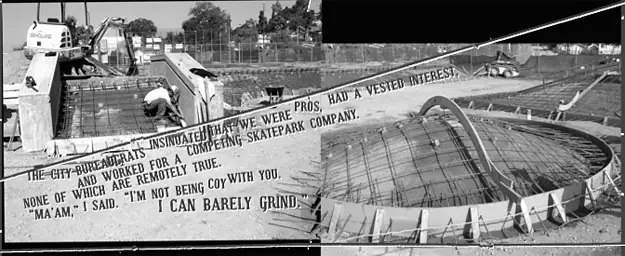
The concrete version of Spohn Ranch in this area is Purkiss-Rose. Here’s how L.A. sucks something special. They claim, “Any California Licensed General Contractor can bid on public bids.” But the fine print is that they only select “one of the firms that they already have a multi-year contract with.” Also, skateparks aren’t considered “specialized projects” -like golf courses are- so it’s really difficult for an out-of-town company to get a bid. Basically, it’s The City’s nice rhetorical trick of never completely showing their hand, while claiming complete transparency. Solely to place a bid with The City, there’s a befuddling amount of politics, thinly veiled cronyism, and ignorance to deal with. With one tenth of the effort and headache, respected companies like Grindline and Dreamland can make parks in other states. Hell, the government agencies in Idaho all but rolled out the red carpet for ’em, while L.A. seems to want to make skateparks completely out of red tape. It boiled down to this: even though Grindline stated that if we could get a design/build contract going, they would design the park for free and build it for that price. The City flatly rejected their offer. Goodbye Grindline dreams. Purkiss-Rose-widely known in skating circles as Darth Vader of skatepark designers-was to design the park… and the landscaping… and the kiddie area.
“See?” they implied, “A skatepark’s nothing specialized. We’re trained professionals. You’ve got nothing to worry about.”
Months lapsed. The City then announced the first community concrete skatepark design meeting. Kids: Bless, ’em, and I can’t blame them; they’d been lied to most of their lives by The City about this skatepark again and again. They were fed up and started slithering out as soon as the meeting began. Hell, if I was in their shoes and had their talent, I’d be skating the stair sets in front of the school instead of sitting though the noise, drainage, and environmental impact studies that started off the meeting.
How to Fight for a Skatepark – By Todd Taylor. Additional photos by Mary Clare Stevens Posted 5-28-08
This article was originally static html. Original comments can be found here.
0 comments.