
How to Fight for a Skatepark – By Todd Taylor. Additional photos by Mary Clare Stevens Posted 5-28-08
This article was originally static html. Original comments can be found here.
…continued from page one
If You Think Someone Has No Pull, Treat Them as Children, Then Blank Face
City Techniques #2 and #3
At the second community meeting, my hopes were still up. I’ve never lived within a skatable distance to a concrete park. I was ready to fight… in a polite, calm manner. I put on my collared shirt and brushed my teeth. I felt all kung-fu’y. I’m pretty used to being treated like a moron. The City obliged in the following fashion: when community members are hypnotized by your spinning wheels of protocol, reveal your plan-that’s really a statement-in the form of a question. Then include many “options” (for that feel-good glow of “community empowerment”). If constituents disagree with you, talk to them like they’re deaf, slow, and speaking another language.
I was horrified that their “options for design” were little more than different reconfigurations of the same modular park. The drill is to lay down a slab of concrete (picture a parking lot), plop metal and wood structures on top. Voilá! Very expensive suckage that’s noisy and breaks. The Ambassador and I were indignant. We came to discuss a skatepark, not a playground. This injustice wouldn’t stand. We were then exposed to…
“Moving Forward” Means Ignoring the Question
City Technique #4
I raised my hand. “What about a purely concrete park with transition and bowls? I think…”
I was stopped cold by a lady who reminded me of a mean-ass, robotic Margaret Cho. She was backed up by a lady whose talent was public relations-style Teflon whose catch phrase was saying, “I know exactly what you mean,” but obviously not listening to anything that countered The City’s plan. “We’ve already discussed the design aspects of the park,” Cho-bot said. “This is not the meeting for that. We must move forward.”
Community members stink eyed the Ambassador and me. They revealed to me later that they were thinking two things when we first crossed paths: “Who are these jokers and why do they want to steal the park away from the kids?” It had taken two years of fighting for the community members to get to this stage in the negations and some clowns weren’t going to waltz right in and yoink it away from them. Fair enough.
The City bureaucrats sensed this discontent and immediately tried to turn the community against the Ambassador and me, insinuating that we were pros, had a vested interest, and worked for a competing skatepark company. (None of which are remotely true. “Ma’am,” I said, “I’m not being coy with you. I can barely grind.”) Apparently, Cho-bot had a hard time conceiving that people could be interested in a project who couldn’t make money directly off of it, nor want to reap any “community” points.
The City acted like something being revealed officially to the community for the first time had already been discussed at length, that it was a foregone conclusion, and that I was wasting their time. “Ladies, I just wanna skate a park without having to drive to it. In thirty-five years, that’s never happened. The Ambassador and I are the only two community members in this room who’ll actually be skating this thing.” Community member Rick Alaniz stood up, frustrated with Teflon, directed his aggravation at her. “We’ve been waiting seven months with unanswered questions.” Many community members in attendance were obviously distraught. Up until the Skate Summit, the City had openly resisted the idea of a skatepark at every juncture.
“There are people in the community who are opposed to the park. We have to take them in consideration, too,” said Cho-bot out of seemingly nowhere.
“Who?” Rick asked, neck tightening.
“It doesn’t matter who they are, Rick. People in the community,” replied Cho-bot.
Rosa Rivas, another community member in attendance, had collected the signatures of each and every home and business owner with a sightline to the park. Before signing, she took them through what the skatepark would mean for the community as a whole and what to expect of the new visitors to their neighborhood. Each and every home and business owner signed the petition. The City had a copy of that list on their clipboard.
“People, Rick. Other people,” Cho-bot repeated. “You’re not the only ones….”
Cho-bot and Teflon’s vagueness was maddening. Many community members were visibly sputtering. How could people who didn’t show up to a meeting, didn’t have to speak publicly, didn’t even have to be named or answer direct questions, have as much weight in the balance for the skatepark as those who’d fought so hard just for the idea of it? The meeting ended abruptly in the middle of a heated discussion. The room was scheduled for another group who brought juice boxes and a man was busy writing something about anger management on the dry erase board. It was agreed that The City would contact the makers of the modular skateparks to see if they were willing to meet directly with the community in a week or two.
Over the next several months, we would painfully find out that there were going to be no direct answers to any of our questions.
Dude, Don’t Be an Asshole
The First Smart Thing for a Skater to Do
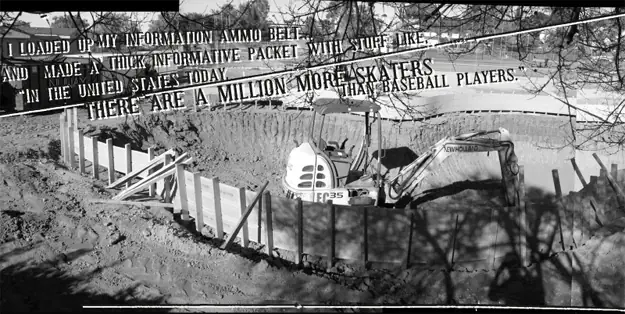
Good folks can often be frightened by things they don’t understand. Don’t just give ’em the finger, complain, “If I have to explain, you’ll never understand!” then cry along to a Smiths record. Take your time-without swearing-to explain what the fuck you’re talking about. I loaded up my information ammo belt. I researched and brushed up on the difference between concrete vs. modular skateparks in reputable, skate-neutral magazines, took pictures and made diagrams that explained what I was talking about, and made a thick, informative packet with stuff like, “In the United States today, there are a million more skateboarders than baseball players.”
I also went on the attack against the proposed skatepark builder. I’ve watched Animal House enough times to understand that the best way to get anything stupid, inspired, and against-all-odds done is to have allies. Just as Bluto couldn’t have sabotaged the parade all by himself; he needed 10,000 marbles. The Ambassador and I needed to show that we weren’t two independent jackasses, but part of Team Highland Park.
There’s this thing called the interweb. It’s full of info on how to rip off Coke machines or make every traffic light you approach turn green (i-hacked.com), but there are also government and corporate documents there. And, as it turned out, Spohn Ranch was its own best enemy. It boasted way too much. The Ambassador and I went to their locally placed skateparks. We took pictures of their indefinitely- closed-for-repairs-after-two-years, looks-like-a-prison-yard in Lincoln Heights four miles away. We winced at the parking lot of jank in Sunland with wood extensions nailed on. We photographed all the splits, breaks, blisters, and holes in their material, Skatelite, which claimed to “withstand the constant punishment inflicted by determined riders.” Not just complainers, we photographed concrete parks nearby (but not technically in Los Angeles)-Glendale and Duarte-and explained why and how they worked. In the packet, we pressed that a skatepark respected by skaters and the community could be made with the money available.
How to Fight for a Skatepark – By Todd Taylor. Additional photos by Mary Clare Stevens Posted 5-28-08
This article was originally static html. Original comments can be found here.
0 comments.